
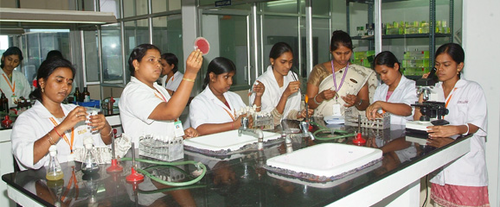
Microbiology Course Fees- The BSc in Microbiology is concerned with the study of microorganisms that exist in our surroundings and have an impact on our survival both directly and indirectly. It is a Biology disciplinary course that focuses on a specific area of Biology. Let us discuss the Microbiology Course Fee.
It helps to understand diseases and their complexities in modern times. It is beneficial to be aware of the potential hazards in our daily lives, as well as the level of precautions required for safe survival. Microbiology now provides a challenging career in a variety of fields such as healthcare, management, food processing, marketing, research labs, and so on.
What are the latest Microbiology course fees in India?
As per data, the fees differ widely between government and private institutions, but here we will explore the course fees for microbiology courses:
| Courses | Fees |
| BSc Microbiology Fees | INR 80,000 to INR 2.5 Lakh per year |
| MSc Microbiology Fees | INR 50,000 to INR 2.5 Lakh |
| Diploma Courses | INR 10,000 to INR 80,000 |
| Certificate Courses | INR 500 to INR 70.000 |
Market Demand
The microbiology professionals are in high demand due to:
- Increasing awareness in the public for diseases,
- Rising need for safety and quality control
- Growth in the pharmaceutical and biotech industries
Why are Microbiology courses in demand?
Microbiologists are in high demand because they play a crucial role in today’s healthcare, research and industrial sectors. The growing need for skilled professionals who understand microorganisms and can develop treatments, vaccines and diagnostic solutions. Other reasons are:
- Rising demand in the healthcare and pharma sector
- Opportunities in vaccine development and research
- Growth in biotechnology and diagnostics
- Global career opportunities
What are the benefits of taking a Microbiology Course?
There is a high demand for BSc Microbiology Courses because the opportunities associated with BSc Microbiology job prospects are quite high in various industries such as pharmaceutical industries, food processing plants, research labs, and so on. The advantages of BSc Microbiology are unique in that it teaches details about microbes and their functions that no other course covers. The following are some of the main reasons why students should pursue a BSc Microbiology degree.
Opportunities– There are numerous job opportunities available after earning an MSc in Microbiology in a variety of industries. They can work as microbiologists, bacteriologists, cell biologists, virologists, mycologists, and many other jobs.
Opportunities for Research– The foundation of this course is research. Microbes rapidly change their genetic composition and structure. A microbiologist’s role is to conduct continuous research on microbes in order to understand the next course of action by microbes, their impact on the environment, the next wave of infectious diseases that may occur, the effect of microbes on various types of food products, and so on.
Higher Education– There is always the option of furthering one’s education in a related field and earning a specialized certificate or degree. MSc programs offer a diverse range of courses, including an MSc in Microbiology, an MSc in Medical Microbiology, an MSc in Microbial Genetics and Bioinformatics, and an MSc in Applied Microbiology.
Microbiology Course Fees
The average fee for BSc Microbiology is INR 3 Lakhs per annum to INR 9 Lakhs per annum. A B.Sc Microbiology program at India’s best microbiology colleges typically costs between INR 20,000 and INR 50,000. This bachelor’s degree program lasts three years.
Microbiology Career Options and Job Prospects
Microbiology is a developing field with ongoing research developments and advancements. There is a lot of room for further investigation and research. Students pursuing a B.Sc. in Microbiology may also be eligible for international education and employment opportunities. Exams are also used by government agencies to hire microbiology graduates for various positions. Microbiology projects are organized by various colleges and zoology labs, and B.Sc. graduates are eligible to apply.
- Bacteriologist
- Virologist
- Mycologist
- Environmental Microbiologist
- Biomedical
- Geneticist
- Biotechnologist
- Cell Biologist
- Industrial Microbiologist
- Biochemist
- Immunologist
- Medical Microbiologist
- Protozoologist
- Food Microbiologist
Dolphin PG College, Chandigarh
Dolphin PG College is one of the most reputable colleges for pursuing Lifesciences courses in India. We have earned several awards from the government of India. Since its inception in 2009, Dolphin PG College has been regarded as the best institution for studying biological sciences. The Indian government’s education ministry has bestowed numerous honors on our college. We are one of the few colleges in India that offers courses in both agriculture and biology.
You can enroll in Dolphin (PG) College of Science & Agriculture to pursue a master’s degree. We offer the best Msc Chemistry courses in India as well as job opportunities. With this degree, you can take a plethora of engaging and industry-specific MSc courses, so working hard will undoubtedly help you build a successful career. Consider the industries in which you want to work, then select the one that best fits your objectives.
The Yuva Education Society in New Delhi manages the college. Please contact us if you have any questions about the Paramedical course we offer at our college or the application process.
Contact Us
WhatsApp Us- 8427244882, 8427244771
Mail- dolphinadmission@gmail.com
Address: 18 Kms, Chandigarh-Sirhind State Highway 12-A, P.O.- Chunni kalan, District – Fatehgarh Sahib. Punjab 140406.
Some of the top microbiology colleges in India
Chandigarh University
This university creates a pool of intellectual thinkers and influential leaders in the field of Science and Technology. This university has a separate department of science and offers foundation courses in Physics, Chemistry and Medical.
- State of the art facilities and student friendly ambience
- With strong global alliances, they give a global vision to your career.
Address: NH-05, Chandigarh-Ludhiana Highway, Mohali, Punjab
University of Delhi
The department is now well established with six faculty members. Extramural grants from DBT, DST, ICMR, CSIR, UGC, ICAR and DRDO, as well as intramural grants from the University of Delhi, strengthened the department’s research.
Address: South Campus, Benito Juarez Marg, South Moti Bagh, New Delhi 110021
SGT University
In this science field, there is a diverse range of healthcare professionals who use their knowledge to assist patients in need of medical care. They use their management and administrative skills to help the healthcare system and patients.
- Diploma Programme in medical laboratory technology, operation theatre technology and optometry.
Address: Budhera, Gurugram-Badli Road, Gurugram- 122505, Haryana, India.
Frequently Asked Questions about Microbiology Course Fees
Is microbiology a promising career?
Microbiology is a lucrative field of study. A Microbiology degree can lead to a variety of professional opportunities. A microbiology degree can lead to the following jobs: Scientist in Biomedicine.
What is the Eligibility for BSc Microbiology?
- The candidate must have completed class 12th with a scientific stream from a recognized institution and board in order to be eligible for the BSc Microbiology program. Chemistry, Biology, and Physics should be required, with English and Math optional.
- Candidates holding a master’s degree in another area may also apply for this course based on their 12th grade and subject of study.
What are the job profiles available after completing a BSc in Microbiology?
The job profiles available after BSc Microbiology are Biologist, Scientist, Professor, Clinic Expert, Virologist, Bacteriologist, and so on.
What is the future score after completing a BSc in Microbiology?
After completing a BSc Microbiology course, one can pursue an MSc in Microbiology or a variety of other subjects, or pursue a variety of job profiles in industries such as healthcare, hospitality, food processing, manufacturing, and management, among others.
What is the average salary after a microbiology course?
The average salary ranges from INR 2 to INR 6 LPA for freshers and with experience, it can go up to INR 8 to 15 LPA.
Is NEET required for microbiology courses?
In most colleges, NEET is not required; admission is usually based on 12th marks or entrance exams conducted by universities.
Can microbiology students work in hospitals?
Absolutely, microbiology students can work as lab technicians, microbiologists and infection control specialists.
Is microbiology a good career option in 2026?
Yes, with the increasing demand in healthcare, biotech and pharmaceuticals, microbiology is a highly promising career option in 2025.